

the faceless name themselves
self definition, pleasure, and scrutiny

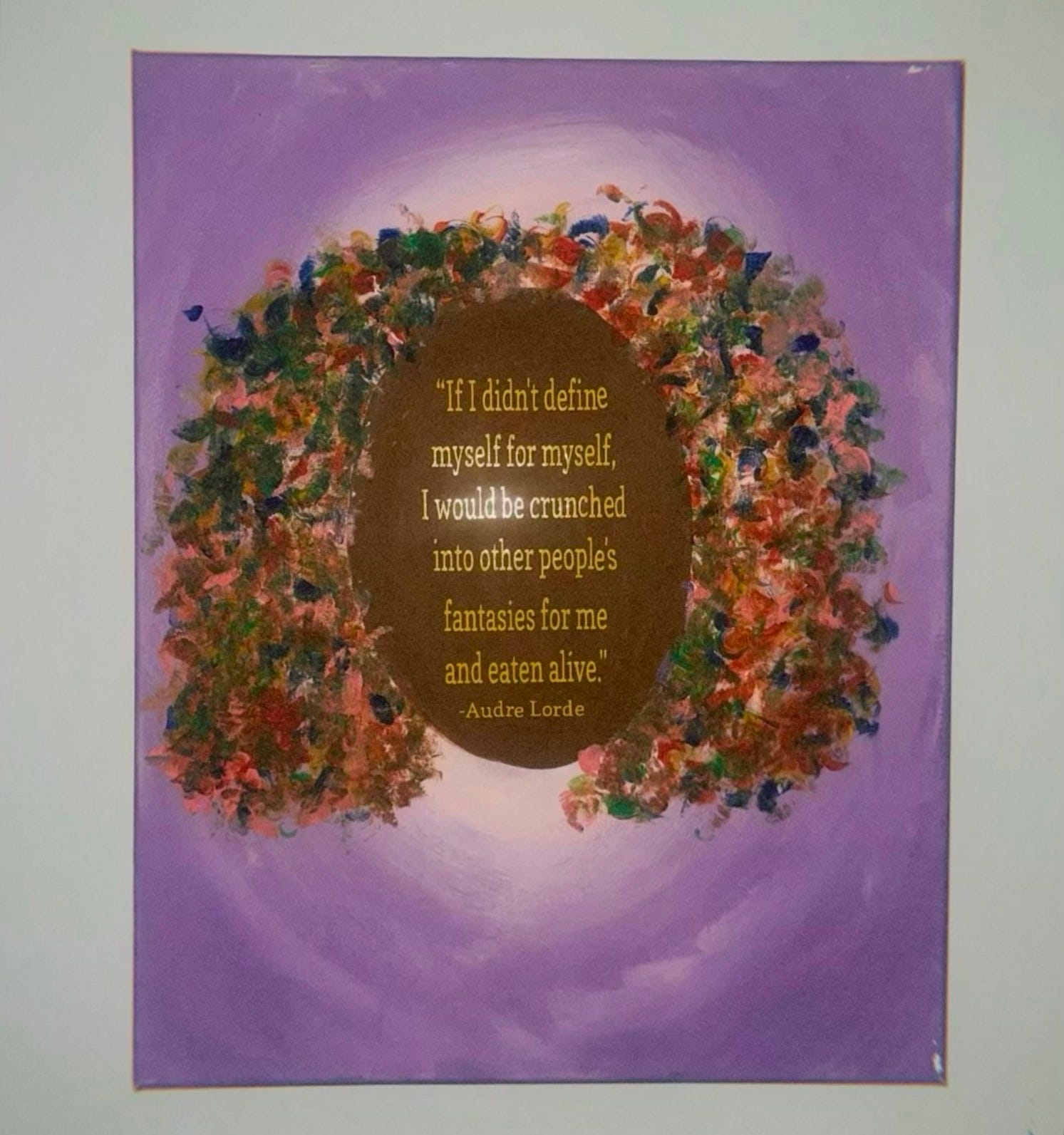
In Poetry is not a Luxury Audre Lorde creates a love letter to writing and expression reminding us that true power requires delving into our depths instead of masking them. She dares us to be honest about our desires. Promises a power that is within our depths. She is keenly aware that there are some truths that will only be divulged in the privacy of our own creations. She reminds us that it is our feelings— the ones that have been bastardized and made out to be weakness that allow us to initiate change in our own lives and the lives of others.
In Uses of the Erotic, Lorde differentiates the erotic from the pornographic,
the erotic being:
“...a measure between the beginnings of our sense of self and the chaos of our strongest feelings. It is an internal sense of satisfaction to which, once we have experienced it, we know we can aspire. 1
and the pornographic is defined as “sensation without feeling.” She is speaking to the opportunity for each of us to be fueled by what feels right to us rather than what mechanically looks good or appeasing to others. When we connect this with our ability to to define ourselves for ourselves we can conclude that defining ourselves, first, means to trust our own feelings as a sense of direction rather than an inconvenience.
Let’s take the desire to feel important. On one hand, this is part of the human condition. When we feel important, we feel necessary, and when we feel necessary, we feel purposeful. What is life without purpose? On the other hand, if the desire to feel important is derived from our feeling a lack of significance we will always be in search of people who fill that void. Everyone has an inherent purpose. Breath is proof of their significance. However, many of us are not tapped in to our significance and run the risk of being defined by anyone who can see something in us.
If our significance, our value, and our worth is not defined by ourselves; If we have not taken the time to know our significance; if we are not in the practice of our significance, we allow people to place us wherever they’d like. And for some of us this works. Being significant in the lives of others is worth the risk of losing the very thing that makes us unique. It feels good, at least for a moment, for someone to recognize that we are, in fact, significant. The ego is boosted and there is a moment where we feel super charged. But this is just a surface level feeling. This is the pornographic—the sensation without feeling that Audre speaks to. We feel good as long as we hold steady the position that someone else has lined up for us. We are nothing more than a mechanism for the the pleasured pursuit of someone else. This is dangerous because we lose touch with our own feelings. We become accustomed to the pornographic. In the motion of what is sensationalized, but detached from our own feelings.
Although, when our desire to be important exists as a recognition of our significance we are aware of what we have to offer. When we allow the awareness of our value to guide us we express ourselves as a form of gratitude. There is nothing to prove. Nothing to assert. No one to impress. There is a desire to act on our significance for it’s own sake. Not for reward, praise, or accolade. We move from a position of purpose. We move from the inside out.
We are students, but never tricked out of our spot. We define ourselves. We chase after no one and nothing. We do not ask to be seen. We are aware that those who see us need not be coerced. We continue to breath, live, and be as a way of defying the gravity of how others would define us.
We soar to new heights, even when we believe that it requires we stand alone. We know that there is not a place on earth that would require we stand alone. We know that alone is not possible. For we, ourselves, are made up of millions.
We hold ourselves accountable for the way that we attempted to shape shift for others. We recognize the ways that we lied to ourselves about what we desired. We give ourselves permission to dream our dream. And we no longer allow others perceptions to become our limitations. We hold ourselves accountable and birth worlds by allowing curiosity to do it’s job. In Poetry is Not a Luxury, Lorde says,
“The quality of light by which we scrutinize our lives has direct bearing upon the product which we live, and upon the changes which we hope to bring about through those lives. It is within this light that we form those ideas by which we pursue our magic and make it realized. This is poetry as illumination, for it is through poetry that we give name to those ideas which are — until the poem — nameless and formless, about to be birthed, but already felt.”2
We define ourselves after having felt what it was like to be mistaken for the presumption of others. We know what it means to exist in a body which is consistently and constantly met with assumption. We have existed as an isolated event knowing that the world, with it's assumptions, encourages us to shrink. When we define ourselves we encourage them to choke and to purge their own presumptions.
We define ourselves for our own sake. Instead of dying to meet the expectations of others; we birth ourselves. We learn to be alive rather than merely existing as a living doll to be taken off the shelf. There is no appeasing here. There is only what we are and what we are not. We accept what we are and leave what we are not up to the universe. We know that at any given moment we are exactly as we should be growing and integrating lessons as we move along.
We create.
We transmute and translate.
We break the mold.
We glitch the system.
Audre Lorde, «Uses of the Erotic », [Paper delivered at the Fourth Berkshire Conference on the History of Women, Mount Holyoke College, August 25, 1978. Published as a pamphlet by Out & Out Books (available from The Crossing Press). Reprinted in Sister Outsider: Essays and Speeches by Audre Lorde, Crossing Press:1984] URL: https://www.centraleurasia.org/wp-content/uploads/2023/02/audre_lorde_cool-beans.pdf
Audre Lorde, «Poetry is Not a Luxury», [2018. The Master’s Tools Will Never Dismantle the Master’s House. Penguin Modern. London, England: Penguin Classics.]